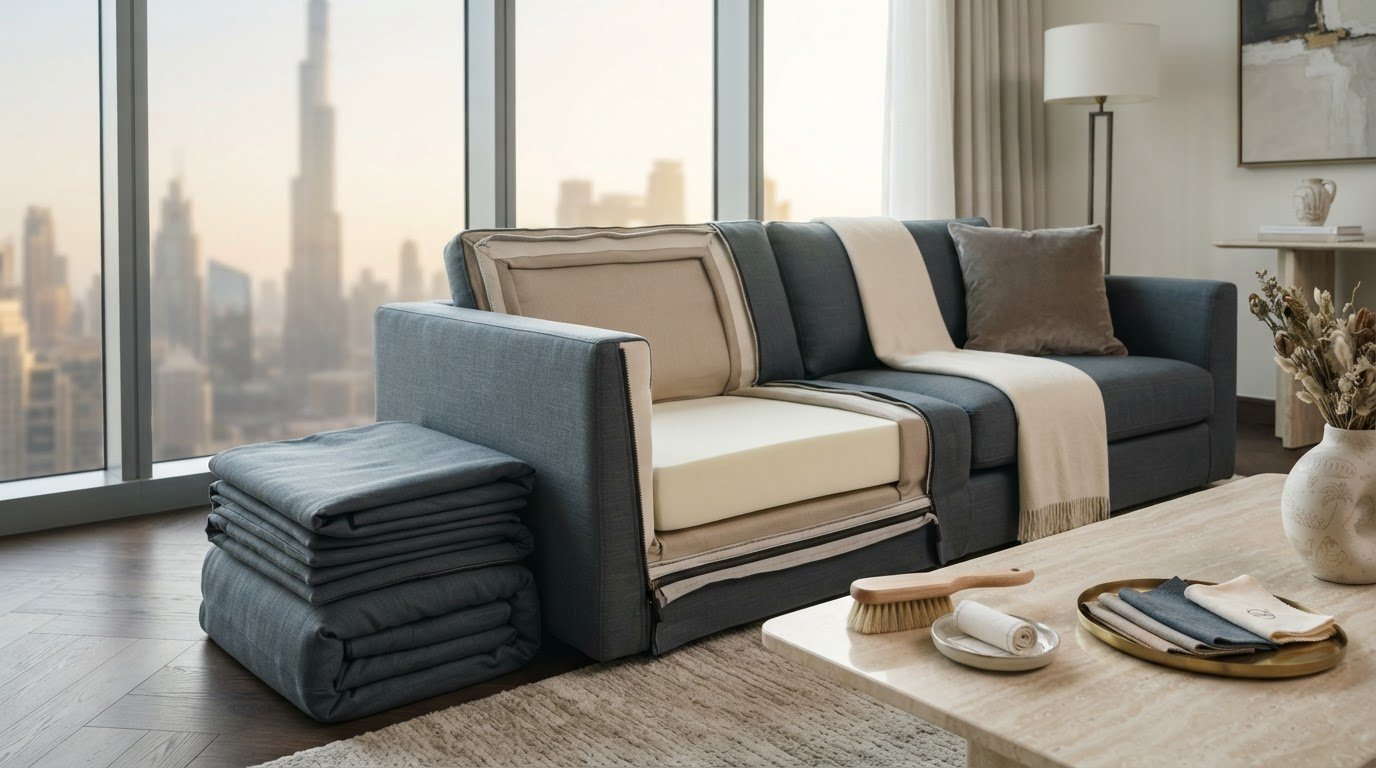
Could the wrong cleaning method do more harm than the dust or marks you’re trying to remove? A search for a sofa cover cleaning service Dubai residents can rely on often starts with that concern, especially when the care label is unclear or a cover seems removable but has delicate seams, linings, or fastenings.
It’s sensible to be cautious. Removable doesn’t automatically mean machine-washable, and a method suited to one fabric may affect another’s colour, texture, or shape. The right approach depends on the material and how the cover is constructed, not simply on the visible stain.
This guide explains how fabric type and construction affect care, what to check before cleaning, and how removable covers differ from fixed upholstery. You’ll also find practical preparation steps for textile care in Dubai, where dust can settle on indoor furnishings. Thawb Wa Teeb provides premium laundry and dry-cleaning services, plus carpet and curtain cleaning, with convenient door-to-door pickup scheduled online or via WhatsApp.
Key Takeaways
- First distinguish removable covers from fixed upholstery; the care route depends on what can safely be removed.
- Use the care label, construction, and condition to guide cleaning choices instead of assuming one method suits every cover.
- Before arranging cleaning, note the fabric details and visible marks so you have a clear starting point for assessing care.
- Photograph the cover, follow removal instructions, and keep matching pieces together where practical.
- Choose a cleaning approach suited to the cover’s care guidance, and don’t expect every stain or odour to respond the same way.
Sofa Cover Cleaning in Dubai: First Identify What Needs Cleaning
Dust on a seat, a mark on an armrest, or a lingering odour can make a sofa feel less inviting. It’s natural to want a thorough clean without risking faded colour, changed texture, or a cover that no longer fits. When looking for a sofa cover cleaning service Dubai residents can use, start with one distinction: are you caring for removable textile covers, or upholstery that remains attached to the sofa?
Sofa-cover cleaning refers to care for removable fabric pieces, such as seat or back cushion covers. Fixed upholstery is different: its fabric stays attached to the frame or padding, so the material and underlying structure must be considered together. A general overview of Upholstery explains how fabric, padding, and supporting components can form one finished piece.
Dubai’s dusty conditions make regular indoor care relevant, particularly for seating used every day. Dust can settle on fabric between cleans, while marks and odours need their own assessment. Identify exactly which textile needs attention before choosing a method, rather than assuming that a process suited to fixed upholstery will also suit a removable cover.
Removable covers and fixed upholstery need different care
A zip makes a cover removable, but it doesn’t explain how the cover should be cleaned. Seams, lining, backing, fastenings, and fit all matter. For example, a cushion cover that unzips may still have a lining or finish that needs gentle handling. Fabric stretched across a fixed sofa frame cannot be removed for separate care.
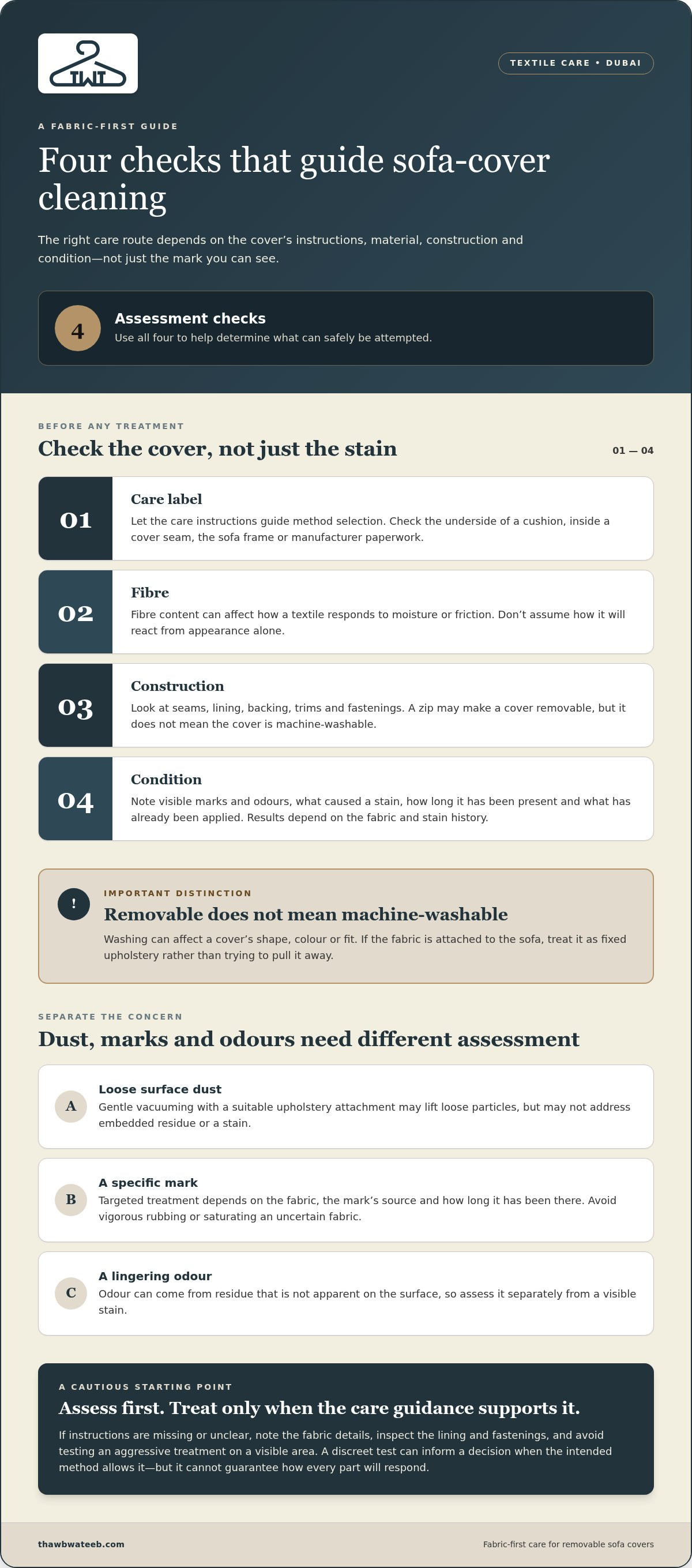
Removal is not the same as machine-washable. Washing can affect shape, colour, or fit, depending on the fabric and construction. Check that the cover is designed to come off, and keep track of which piece belongs on each cushion. If fabric is attached, treat it as fixed upholstery rather than trying to pull it away from the sofa.
Read the label before choosing a cleaning method
Look for a care label on the underside of a cushion, inside a cover seam, or on the sofa’s frame. Manufacturer paperwork may also include cleaning instructions. Fibre content can influence how a textile responds to moisture or friction, while colourfastness affects whether colour may transfer during cleaning. Neither is safe to assume from appearance alone.
The care label guides method selection; the fabric and construction determine how its instructions apply.
If the label is missing or unclear, avoid testing an aggressive treatment on a visible area. Note any fibre information, inspect the lining and fastenings, and record visible marks or odours before deciding how to proceed. This quick assessment helps you weigh the cover’s condition and care requirements before cleaning.
How Professional Sofa Cover Cleaning Should Begin
Careful cleaning begins with assessment, not a preset sequence of products or equipment. The cover’s label, fibre, construction, and condition help determine what can be attempted and where caution is needed. When comparing sofa cover cleaning service Dubai options, look for an approach that considers the removable textile on its own terms rather than treating it like fixed upholstery.
Assessment before treatment
Start with the care instructions, then examine the fabric in good light. Note the type and location of each mark, along with seams, trims, backing, and lining. Consider the risk of colour transfer, especially on patterned or richly coloured material. If the intended method allows it, testing a discreet area can show whether the fabric reacts before treatment reaches a visible panel. A test can inform the decision, but it can’t guarantee how every part will respond.
Assessment should come before treatment because the same mark can call for different care on different fabrics.
What cleaning steps can and cannot establish
Inspection helps identify constraints; dust removal addresses loose surface particles; targeted treatment focuses on a particular mark; and careful drying helps prevent damp fabric from being put back into use too soon. These are decision points, not a universal recipe. The correct sequence and products depend on the cover’s care guidance, fibre, finish, and construction.
Surface dust and deeper soiling are different problems. Gentle vacuuming with a suitable upholstery attachment may lift loose particles, but it won’t necessarily address embedded residue or a stain. A deeper treatment involves more moisture or cleaning agents, so it requires closer consideration of the textile. Avoid vigorous rubbing or saturating an uncertain fabric; either can spread a mark or affect the finish.
Assess stains and odours separately. A visible mark may have a known source, while an odour can come from residue that isn’t apparent on the surface. Note what caused the stain, how long it has been present, and what has already been applied. Previous treatment can change how a mark responds, and results depend on the fabric and stain history. No inspection can promise complete removal.
For broader textile-care context, Premium Laundry in Dubai: The 2026 Guide to Meticulous Garment Care discusses garment care. Garment cleaning processes shouldn’t automatically be applied to sofa covers. The same fabric-first principle is useful across textiles: understand the item before selecting its care route.
Once you know whether the concern is loose dust, a specific mark, or a persistent odour, you can describe it clearly and make a more informed care decision. Thawb Wa Teeb also provides carpet and curtain care for other home textiles.
Sofa Cover Cleaning Methods Compared: Match Care to the Fabric
No single method suits every removable sofa cover. A light surface refresh and a deeper response to a mark are different needs, and moisture, heat, or vigorous agitation may affect some fabrics, finishes, or construction. Use the manufacturer’s care label as your reference point, then compare the purpose and limits of each option. A careful sofa cover cleaning service Dubai search should prioritise fabric suitability over a one-method-fits-all promise.
Routine vacuuming versus deeper fabric treatment
Vacuuming can lift loose dust and crumbs from the surface, making it useful for routine upkeep. It won’t necessarily remove a set-in mark or resolve an odour. Deeper treatment may be considered for persistent soiling, but only when the label and fabric allow it. Match the level of care to the problem instead of defaulting to the most intensive option.
| Method | Purpose | Limits and cautions |
|---|---|---|
| Routine vacuuming | Remove loose surface dust and debris. | Doesn’t replace stain or odour treatment. Use a suitable attachment and avoid pulling at delicate seams or trims. |
| Damp spot care | Address a small, localised mark when the care instructions allow moisture. | Too much water or rubbing may spread a mark, affect colour, or leave the fabric uneven. Follow label guidance and use restraint. |
| Professional assessment | Consider the cover’s fabric, construction, and cleaning needs before choosing a deeper treatment. | Assessment can guide method selection, but it can’t guarantee complete stain or odour removal. Suitability depends on the item and its condition. |
Why material and construction change the comparison
Natural and synthetic fibres are broad categories, not cleaning instructions. Fabrics in either group can differ in weave, dye, finish, and response to care. Backing, trims, linings, and seams add further considerations. A cover that looks sturdy on the front may include components that react differently to moisture or handling.
Take particular care with construction that may shrink. Even a cover that appears simple can be difficult to refit if its shape changes. Heat and agitation can affect some materials, so don’t assume a method is safe just because it’s commonly used on other upholstery. Recheck the care label before treatment, especially if it gives restrictions or the fibre content is unknown.
Think of this comparison as a decision aid, not a fixed ladder from lightest to strongest. Loose dust may call for routine vacuuming; a small mark may need a different response; persistent or unclear issues may warrant a professional assessment. Choose an approach that aligns with the cover’s care instructions and construction.
Prepare Sofa Covers for Cleaning and Keep Them Looking Refreshed
A little preparation can protect the cover’s shape and make its condition easier to track. Before arranging cleaning, record the cover’s current state, follow the manufacturer’s removal instructions, and keep each piece organised. These steps help prevent mix-ups and give you a clear reference after care.
A simple preparation checklist for removable covers
- Photograph the sofa and covers. Capture the overall arrangement and any existing marks, pulls, or colour variations before handling.
- Check the care label. Note the cleaning guidance and any restrictions before removing or treating a cover.
- Inspect fastenings and seams. Look for zips, buttons, loose stitching, delicate trim, or signs that a cover may not be designed for removal.
- Keep matching pieces together. Group covers by cushion or position, and keep ties or detachable parts with the correct piece.
- Record marks and spills. Note their location and, if known, what caused them and whether a previous treatment was used.
Only remove covers when the manufacturer’s instructions permit it. If a fastening resists or a seam appears strained, don’t pull harder; forcing removal can damage the textile or stitching. Keep track of cushion positions while covers are away, or label the pieces discreetly so each one returns to the correct place.
After-cleaning care and drying
Follow the care label’s drying directions and allow each cover to become fully dry before refitting. A damp cover may be difficult to position smoothly. Don’t use high heat, forceful stretching, or aggressive tugging unless the manufacturer explicitly allows it. If the cover feels tight, pause rather than forcing it over the cushion.
For a fresh spill, act promptly but gently: blot rather than scrub, and use only the care approach permitted by the label. Rubbing can work a mark further into the fibres or roughen the surface. If the spill persists or the instructions are unclear, avoid improvised treatments that may make later care more difficult.
In Dubai, dust can settle on indoor seating, so a brief visual check and light routine upkeep can help you notice new marks early. Drying conditions vary by room; don’t assume a cover will dry safely just because the room feels cool. Follow its care guidance and keep it laid or supported as instructed.
For other home textiles, you can explore carpet and curtain care from Thawb Wa Teeb.
Finding the Right Textile-Care Support in Dubai
The right care route depends on the item, its construction, and the instructions attached to it. For a sofa cover, first establish whether it’s removable or fixed, then use its care label to guide the next step. Keep that distinction in focus: removable covers are separate textiles, while fixed upholstery remains attached to the sofa and its padding.
Choose support based on the textile item and care need
Different household textiles call for different considerations. Garments have their own care labels and construction; curtains and carpets are larger home textiles; removable sofa covers are shaped fabric pieces; and fixed upholstery stays on the furniture. Treating these as interchangeable can lead to unsuitable care, so identify the item before deciding what kind of support is relevant.
Thawb Wa Teeb provides carpet and curtain cleaning as part of its textile-care offering. For more context on those furnishings, the Elite Carpet and Curtain Cleaning Service in Dubai: The 2026 Preservation Guide explores carpet and curtain care. For sofa covers, use the sofa’s own label and construction to guide care decisions.
A practical decision path is simple: identify the textile, read its care instructions, and choose a care route that matches both. If the sofa fabric is fixed, don’t treat it as a removable cover. If the cover comes off, its label still determines what handling may be suitable.
A convenient way to arrange confirmed textile-care services
Thawb Wa Teeb provides premium laundry and dry-cleaning services, with free door-to-door pickup scheduled online or via WhatsApp. The company also offers carpet and curtain cleaning. These services make it convenient to arrange professional care for garments and home textiles in Dubai.
Before arranging care, have the item type and care instructions to hand. Clear details help you prepare the item appropriately. For a carpet or curtain, consider its size and condition; for garments, follow the care label. Sofa-cover and fixed-upholstery decisions remain guided by their own manufacturer instructions and construction.
For premium garment care, laundry, or carpet and curtain cleaning, explore Thawb Wa Teeb’s textile-care services.
Make Your Next Care Choice With Confidence
Before taking the next step, keep the sofa’s care label and any useful notes about its condition close at hand. They can help you make a more informed choice, especially if the fabric, finish, or construction is unfamiliar. A thoughtful sofa cover cleaning service Dubai search focuses on care suited to the specific cover, rather than a convenient-sounding method that may not fit its needs.
Use the same considered approach for other textiles in your home. Choose care according to the item, and keep garment care distinct from home furnishings. When you’re ready to arrange care for garments, laundry, carpets, or curtains, explore Thawb Wa Teeb’s textile-care services.
Every fabric has its own care needs. With the right information in hand, you can take the next step calmly and give each textile appropriate attention.
Frequently Asked Questions
Can I put removable sofa covers in the washing machine?
Only if the care label or manufacturer’s instructions allow machine washing. A removable cover may contain a fibre blend, lining, backing, or fastening that responds differently to washing than the outer fabric. Check the stated temperature and cycle guidance, and consider whether the cover can fit comfortably without being compressed. If the instructions are missing or unclear, avoid using the machine until you understand the care requirements.
How do I know whether my sofa cover is removable?
Look for zips, buttons, ties, or other fastenings around cushion covers, but don’t assume every removable-looking piece is designed to come off. A loose seat cushion may lift away while its fabric remains fixed around the frame. Check the sofa maker’s instructions before unfastening anything, and stop if a seam catches or the fabric resists. Removing a cover forcibly can damage stitching or alter how it sits.
Can steam cleaning damage sofa covers?
It can affect some covers, so steam shouldn’t be treated as a safe default. Suitability depends on the fabric, finish, construction, and manufacturer’s care instructions. A cover with delicate trim or backing may respond differently from a plain, sturdy textile. If the label doesn’t permit heat or moisture, don’t assume steam is appropriate. Choose a care route based on the specific cover, not simply the cleaning method’s popularity.
How long do sofa covers take to dry after cleaning?
There isn’t one reliable drying time for every cover. Fabric thickness, how much moisture was used, the cleaning method, and airflow in the drying area all affect the result. A light cover in a ventilated space may dry differently from a lined or densely woven one. Follow the care label, avoid unapproved heat, and wait until the cover is dry throughout before placing it back on cushions.
How often should sofa covers be cleaned in Dubai?
Set a routine based on how the sofa is used, household conditions, visible soiling, and the cover’s care guidance rather than a fixed calendar. A cover on a frequently used family sofa may need attention sooner than one in a rarely used room. In Dubai, check for settled indoor dust as part of regular upkeep, then use the label to guide any cleaning beyond light maintenance.
What should I do if a stain remains after cleaning a sofa cover?
Pause before treating it again. Repeated applications or vigorous rubbing can affect colour and texture, particularly if the fabric’s response is unknown. Check the care instructions and note what product or method has already been used, since previous treatment may influence what’s suitable next. Avoid combining cleaners or applying heat unless the label allows it. If the mark persists, choose a next step suited to that fabric rather than experimenting.